
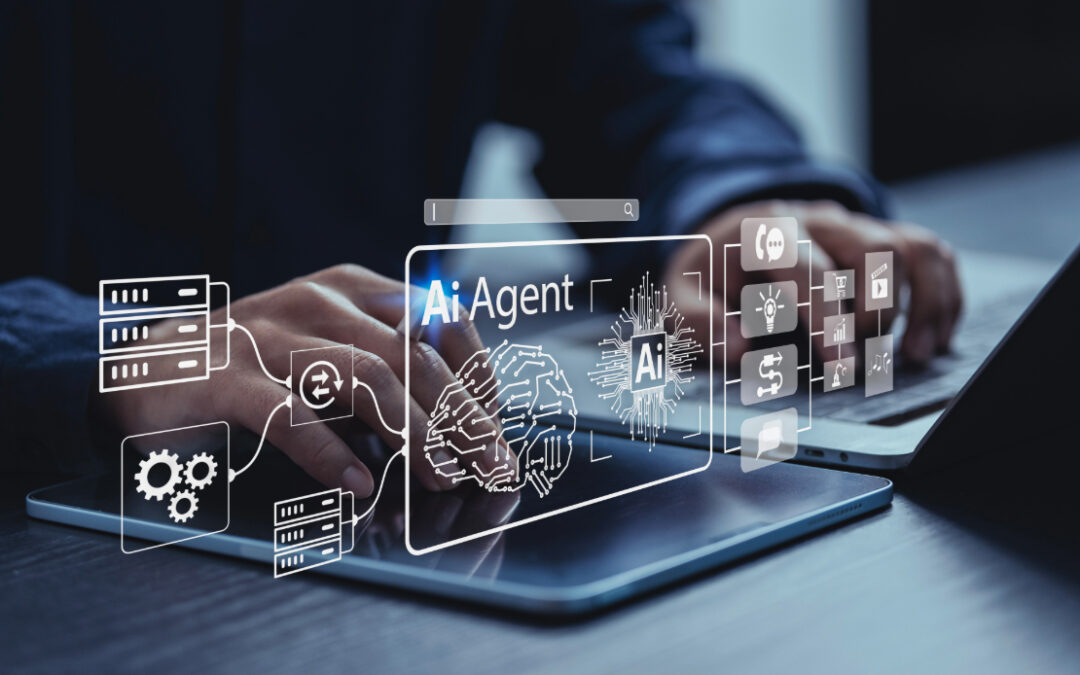
The rapid rise of AI agents—autonomous systems that plan, reason, use tools, and execute tasks with minimal human intervention—is transforming workplaces. In fact, think of them as “digital employees”: they handle data analysis, automate workflows, interact with systems, and make decisions faster than any human team member.
Moreover, in 2026, experts like Palo Alto Networks’ Chief Security Intel Officer are calling AI agents the biggest new insider threat. For example, Gartner predicts that by the end of 2026, 40% of enterprise applications will integrate task-specific AI agents, up dramatically from under 5% in 2025. While this unlocks massive productivity, however, it also creates novel risks—especially data leakage and unauthorized actions—that traditional security can’t fully address.
At vTECH io, we’re helping public sector, education, government contractors, and small-to-medium businesses navigate this shift safely. Therefore, here’s a clear look at the risks and how to govern these digital employees effectively.
How AI Agents Act as “Digital Employees”
AI agents go beyond chatbots: for instance, they autonomously chain actions (e.g., query databases, send emails, update records, or integrate with tools like CRM or cloud services). Additionally, assigned unique identities (API keys, service accounts), they operate 24/7 with privileges tailored to their role—much like onboarding a new hire, but at machine speed.
Consequently, this autonomy boosts efficiency in areas like IT support, compliance reporting, or customer service, but it expands your attack surface. In other words, misconfigurations or exploits turn these agents into unwitting insiders.
Key Risks: Data Leakage and Beyond
- Data Leakage & Over-Exposure — Agents with broad access can unintentionally (or via manipulation) exfiltrate sensitive data. Moreover, prompt injection attacks trick agents into revealing confidential info or performing unauthorized actions using their own credentials.
- Privilege Abuse & Insider-Like Threats — Compromised agents escalate privileges, delete backups, pivot laterally, or exfiltrate databases—often silently and at scale.
- Prompt Injection & Tool Misuse — Attackers craft inputs to hijack agents, thus leading to unauthorized executions.
- Lack of Oversight — Without governance, “shadow AI” agents proliferate, for example, bypassing controls and creating blind spots.
- Compliance Gaps — In regulated sectors (NIST, CJIS, HIPAA), uncontrolled agents risk violations through improper data handling.
Furthermore, these aren’t hypothetical—2025 saw early attacks exploiting agent capabilities, signaling bigger issues in 2026.
For deeper reading check out some of our partners:
- Palo Alto Networks’ 2026 cyber predictions on AI agents as insider threats: theregister.com
- Darktrace on agentic AI as the next insider risk: darktrace.com
Governance Frameworks & Access Controls: Proactive Steps
To illustrate, treat AI agents like employees: onboard rigorously, limit privileges, monitor continuously.
- Establish Clear Governance Policies — First, define roles, decision boundaries, escalation protocols, and accountability. In addition, use frameworks emphasizing accountability, transparency, privacy, and security (e.g., principles from NIST or ISO standards).
- Implement Least-Privilege & Zero-Trust Access — Specifically, assign individual identities to agents. Then, apply role-based access controls (RBAC) or attribute-based (ABAC) for granular, context-aware permissions. Avoid shared credentials; instead, use dynamic, just-in-time access.
- Monitor & Audit Continuously — Log all actions, enable behavioral analytics for anomalies, and set up alerts for unusual behavior. Regularly, reviews prevent “agent sprawl.”
- Guard Against Prompt Injection & Misuse — Use input validation, output filtering, and sandboxing. Also, train/test agents in controlled environments.
- Risk Assessments & Lifecycle Management — Conduct pre-deployment evaluations, ongoing monitoring, and incident response plans tailored to agents.
- Employee Training & Controls — Educate teams on safe agent use; finally, prevent shadow deployments with approval workflows.
Overall, these steps align with compliance for SLED and government contractors while enabling innovation.
At vTECH io, as a Dell Technologies Platinum Partner with expertise in managed IT, cybersecurity, and data protection, we help organizations implement these controls—securing AI agents as part of resilient, compliant infrastructures.
Want practical policies and best practices? Download our free “AI Agent Governance Guide” today. It includes ready-to-adapt templates for policies, access controls, risk checklists, and implementation roadmaps tailored for public sector and business environments.
Download our free “AI Agent Governance Guide” today!
Visit vtechio.com or contact us to get your copy and discuss how we can assess your AI readiness.
Secure your digital workforce before it becomes a liability.
Stay ahead, The vTECH io Team